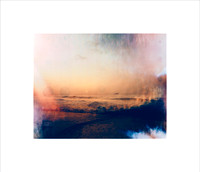
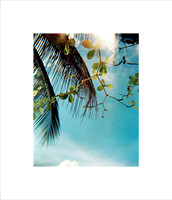
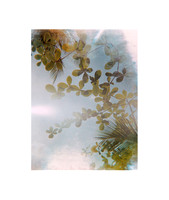
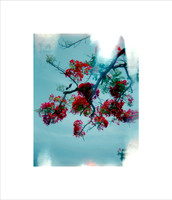
In 2003, whilst London demonstrated against the Gulf war - and Iraq continued to burn - I was living out some of my own pirate dreams, travelling in the West Indies.. As it goes.
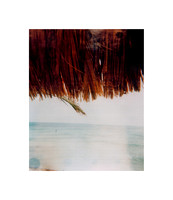
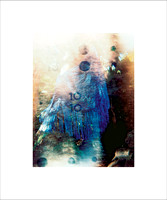
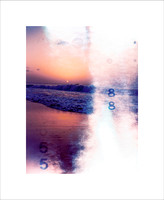
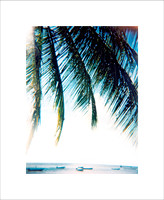
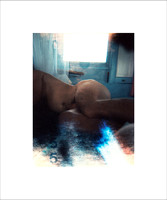
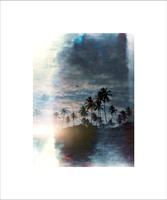
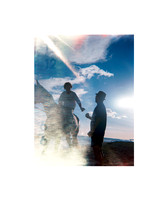
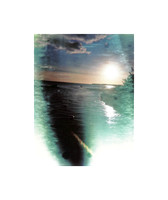
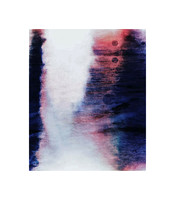
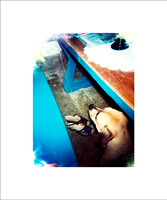
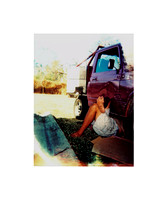
I had with me a camera that I discovered could leak light, into where it was exposing the strip of 120mm film inside. Not only did this leakage burn the sensitive film as it rolled through the spools inside, it would also randomly 'brand' the numbers, dots and arrows from the film's protective carrier strip onto the consequently exposing negatives. I found this serendipitous process fascinating - eloquent and evocative. The photographs I was taking were of the ‘paradise’ that the Caribbean can offer up. They are about the textures and symbols embedded in the negatives - that were, for me, an echo of the radar screens - the voyeuristic footage we were being shown on the news - of a war being fought a million miles away….
In the following year I showed the photographs in various beautiful places - a gallery on Tobago, a house in Notting Hill… And in 2009 I chose to show them again, in a picturesque courtyard of a finka in the hills of Ibiza, luxuriously tucked away from another unfolding crisis. I remember feeling then just how resonant with the idea of 'cocoon' these photographs had become for me…And how an idea is constantly being re-created out of a balance of momentarily defined contrasts.
What do we feel when some of us may be able to escape into beauty and comfort whilst others are suffering? Is this indeed escape from a price that may be being paid somewhere else … Or is conversely an equilibrium somehow also being found? Rumi wrote that the soul is here for its own joy. And we are shown that by focusing on the ills we merely add to them...become paralysed in our creative ability to respond as a whole. I contemplate this still, riding a balance of the trade winds between allowing and resistance as I do also…
“ ...for the object of a great revolution is the attainment of clarified, secure conditions, ensuring a general stabilisation, on the basis of what is possible at the moment.”
– Richard Wilhelm’s translation of the "I Ching: Or, Book of Changes" (Princeton NJ: Princeton University Press, 1967, 1st ed. 1950)
___